



Stay informed
Subscribe to our newsletter, our monthly look at food and non-food quality management.
The discussion about the use of meat terms for plant-based products is increasingly flaring up, both in the Netherlands and the European Union. Will terms like "minced meat," "burger" or "sausage" soon be allowed to be used for vegetarian alternatives? And what does this mean for producers who have been building on these designations for years? Vivera and Bobeldijk tell more about this.
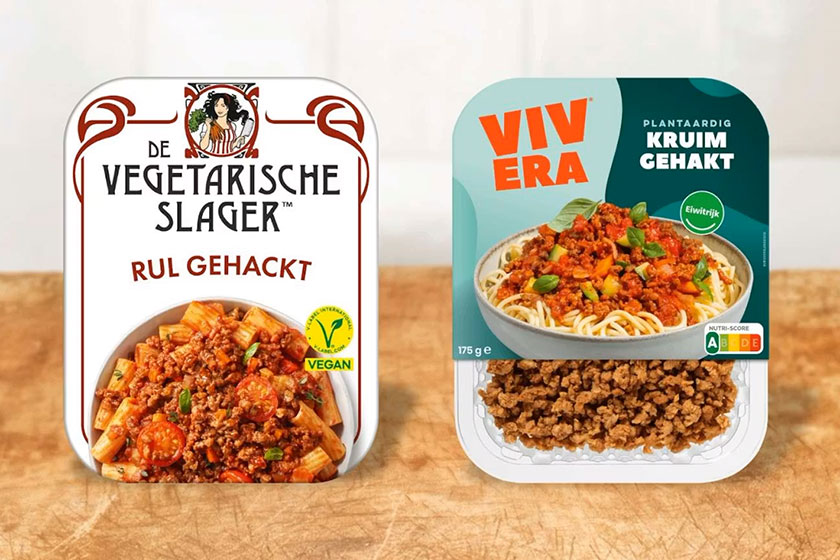
For this article, we spoke with Willem van Weede, CEO of Vivera Foodgroup, which since September 2025 continues together with De Vegetarische Slager as The Vegetarian Butcher Collective. We also spoke with Anne Ardts, junior product manager at Bobeldijk, an originally butcher shop that has been producing exclusively vega(n) products since 2020.
In the Netherlands, commodity acts such as the Warenwetbesluit Vlees, gehakt en vleesproducten reserve terms like 'gehakt' and 'tartaar' exclusively for meat products. Also in combination with 'vegetarian', or with a spelling error, these names are not allowed for vegetarian products.
Still, such products are mostly found on the shelf. For example, De Vegetarische Slager uses the designation 'hacked'. This not only refers to minced meat, but should also express that the company has succeeded in 'hacking' animal meat.
According to Anne Ardts (Bobeldijk), recognizable names such as minced meat are important to convince flexitarians in particular to choose a meat substitute. At the same time, she notes that the current generation is increasingly preparing plant-based meals themselves, without sticking to the "potatoes-vegetables-meat(substitute)" habit.
In October 2025, the Dutch Food and Consumer Product Safety Authority (NVWA) issued warnings to several producers and retailers for using reserved meat designations for vegetarian products. Fierce protests followed and a petition started by ProVeg Netherlands. In November 2025, the NVWA said it would for the time being refrain from enforcing the so-called meat law until it is clear how the European Union intends to approach the issue.
Willem van Weede (Vivera) calls it a good thing that the NVWA decided to wait for the European discussion. In fact, according to the CEO, we need to put the discussion in a broader perspective. "In the long term, we will have to turn some major knobs to ensure that we can live with many people in the world. One of the most important things is that we not only have to take care of our personal health, but also the health of the planet."
In December 2024, the European Commission published a legislative proposal aimed at strengthening the position of farmers in the food supply chain. Through amendments to Regulation (EU) 1308/2013 on the common organization of the markets in agricultural products and the Common Agricultural Policy (CAP). The negotiations propose several amendments limiting the use of meat terms for vegetarian and vegan products.
According to Van Weede, this is the wrong tool to make a stand. "European governments try to make up towards agriculture what cannot be made up. Such as unclear agricultural policies and uncertain prospects for farmers. The assumption is that an anti-planting policy somehow helps livestock farming. It is very symbolic, focused on emotions and not rational. That is neither good nor helpful."
Last year, the European Parliament voted for a change to limit the use of names such as steak, sausage or (ham) burger to products containing meat. The Council of the EU voted against this. Negotiations will continue next year.
According to Ardts, there is no direct connection between the designation 'burger' and meat. "This name mainly defines the form and not the product itself. It is something you serve on a bun with some other additions." This is too gray an area to place restrictions on, according to Ardts.
In July 2025, the Commission proposed to reserve certain designations for meat products directly related to meat, such as beef, chicken and shoulder, as well as bacon and drumstick.
For a change to pass, both parliament and council must vote in favor. These processes can take some time. This is not the first time the EU has discussed limiting meat terms for meat alternatives. Previously, however, no agreement was reached on this.
When asked if Bobeldijk and Vivera are preparing for a meat-meat ban, they respond in the negative. "We take into account a possible ban from the EU, but our main goal is to make tasty plant-based products," Ardts explains. Van Weede also says he will continue to use the discussed terms for the time being. He points out that with a ban, there will be a transition period. "Then it will be time to get creative with names."
Van Weede doesn't just look at the discussion negatively. "The topic itself is great marketing for the category. There was an awful lot of attention for something that in my view should ultimately be a non-issue."
Whether the vegetable sector will continue to exist in the future, Ardts and Van Weede do not doubt it. According to Ardts, the market is dynamic enough to adapt to any ban. Van Weede has seen the vegetable sector grow in recent years. A growth he expects will continue regardless of the uproar over product names.
The industry is constantly evolving, which promotes aspects such as taste and health. In addition, the availability of veg products is increasing, as they are available in more places and becoming cheaper. Van Weede expects vegetarian products to change from niche product to mass product in the coming years. "That's not just hope, there are actual signs of that," he said.
Our Regulatory Affairs Support team is here to help. For more information, please contact us at [email protected], NL +31 (0)30 65 66 010, or BE +32 (0)3 616 08 69.
Subscribe to our newsletter, our monthly look at food and non-food quality management.
Is there anything I can help you with?