

Get a grip on raw material hazards with GINO.












Précon strengthens your HACCP approach with GINO.
GINO is a software for your hazard analysis and verification plan. As a user, all you have to do is enter your suppliers with their products and link them, GINO does the rest.

Hazard Analysis
Automatically identify hazards and risks of your raw materials and always work with a complete analysis.

Verification plan
Automatically generate a verification plan with actions by product and supplier.
Demo
Discover for yourself how to easily meet HACCP obligations for purchased products with GINO.
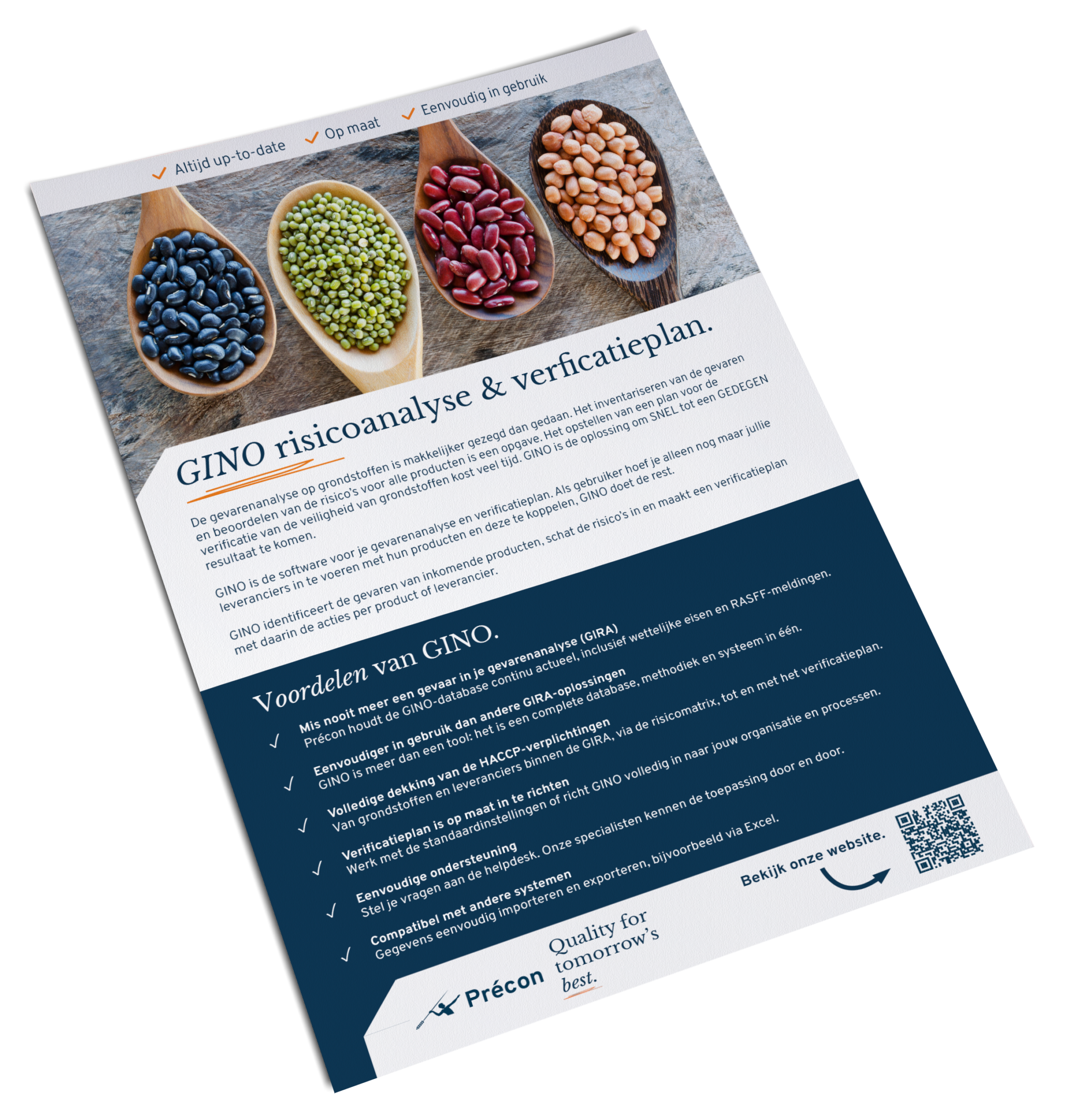
GINO brochure
One clear document in which you will discover what GINO is and what the benefits are for your organization.
- Automate your hazard analysis and save time
- Always up-to-date with legislation and RASFF notifications
- Instant verification plan with actions by product or supplier

Quality management at Beltaste


Versatile partner of Jumbo

Interim QA support at Astra Sweets

Handbook and training at Fundament 2060

Hazard Analysis
With GINO you easily meet the legal HACCP obligations for purchased products. You effortlessly prepare a hazard analysis for raw materials and always keep your HACCP approach for purchased goods up to date.
Our editors keep the GINO database continuously updated with all relevant food safety hazards. The database contains current EU legislation, applicable standards, market developments and the latest RASFF notifications.
Your GINO environment is set up on the basis of your product groups. By linking to our database, the hazard analysis of these product groups is automatically kept up to date.

Verification plan
The hazards that may occur in a product must be controlled. This responsibility lies with the supplier. You select the right supplier and make clear agreements about controlling risks. Verifying this amounts to assessing the reliability of the supplier.
How you organize this is laid down in a verification plan. This takes into account Infosheet 64. Précon helps you make the right, practical choices. GINO then easily translates these choices into a concrete and workable verification plan.

Demo
See in a demo how easy GINO works. Discover how our database contains all relevant and detailed information and assess its applicability for your situation.
In a short online session, we'll take you through GINO and answer all your questions.
The benefits of
GINO.

Complete and reliable database
Inventory of nearly 200 hazards including origin, nature and potential impact on people and product.

Fully compliant with HACCP
From hazard analysis and risk matrix to verification plan - all in one structured methodology.
Practical, flexible and always up to date
Easy to use, adaptable to your situation and always up-to-date.

Frequently asked questions.
GINO helps you sort out all raw material hazards associated with the raw materials you use. And GINO keeps your plan up to date by keeping track of current events, legislation and RASFF notifications.
GINO contains a database of hazards linked to product groups, the probability and severity of which have been estimated by our editors, from which the risk is determined. After linking your purchasing products to the database, GINO provides a hazard analysis and the verification plan, after which you only have to do the implementation.
The database is designed for manufacturers, wholesalers, retailers, private label holders, importers and exporters who are serious about their hazard analysis.
The database contains nearly 200 hazards linked to 25 product groups divided into more than 240 subgroups. This classification is similar to the classification used in legislation. As a result, there is a clear relationship in GINO between the 40 different laws behind the database.
In recent years, Précon has established an extensive database with information on nearly 200 different hazards. The sources for this are European legislation (including Regulations 2023/915, 2073/2005 and 2019/1793 and 40 more laws), scientific literature and the RASFF (Rapid Alert System for Food and Feed) system.
GINO contains comprehensive information on the raw materials and products in which these hazards may occur, on the norms in legislation or in other standards, on the harm these hazards may cause to consumer health, and on the nature and origin of the various hazards.
Performing a raw material hazard analysis is an essential part of the HACCP plan. With a thorough hazard analysis you ensure as a company that hazards in purchase products can be better controlled and you prevent that hazards are brought into the company via the raw materials. In addition, the NVWA also makes it mandatory and has drawn up info sheet 64.
GINO helps you to comply with the statutory obligation for HACCP and with info sheet 64. GINO does this by mapping out the risks associated with purchasing products and how the assurance of these hazards can be verified. GINO produces a hazard analysis and verification plan for you.
After purchasing GINO, the user enters his suppliers along with the products supplied. This can be done easily through an Excel file or by adding an individual supplier or raw material. The user then links the raw material to one of the product categories in GINO's database. GINO's database is updated every week with information from legislation, RASFF and various scientific reports from EFSA, RIVM or NVWA.
By linking to the database, GINO determines which hazards are associated with the raw material, which legislation goes with it and what the associated risk (probability x severity) is. This risk can be adjusted by the user as they see fit.
The user then enters the reliability of the various suppliers. The combination of commodity risk and supplier reliability forms the basis for the verification actions. Through an adjustable decision model, the user determines what is an appropriate verification action.
GINO compiles the various actions into a verification plan that indicates the verification action per raw material and per supplier. GINO also uses this to ensure a good substantiation of the sampling and analysis plan.
Procedures for raw materials and suppliers are seen as essential in certification audits, and the schemes are constantly tightening their requirements. In Infoblad 64, however, the Netherlands Food and Consumer Product Safety Authority (NVWA) indicates that a certified supplier still does not offer sufficient guarantees. Additional measures, such as analyzing samples or auditing suppliers, are often very costly and should therefore be used only where the risks are highest.
GINO helps easily understand which raw materials need to be sampled, which certificates of analysis need to be included, and for which suppliers an audit is appropriate.
At Précon, GINO editors work continuously on the database, ensuring that changes in legislation and legal limits are included in GINO, as well as RASFF notifications and scientific studies from reputable sources, such as EFSA, RIVM, WUR, etc.
The system is updated continuously. That latest date of update is visible in the system when you are logged in.
A consultant will guide you in setting up GINO. You can fill GINO with your products yourself. The Précon consultant will be happy to do this for you, should you prefer.
GINO currently uses sources from European and Dutch legislation. In addition, RASFF notifications are monitored.
At present, GINO is only available in the Dutch language. Using the automatic translator in your web browser, you can easily read GINO in any language.
At this time, no links are technically possible. However, hazard analyses and verification plans can be downloaded to Excel. In addition, the setup allows us to take into account the data contained in the ERP system so that they are well matched.
General information
GINO helps you sort out all raw material hazards associated with the raw materials you use. And GINO keeps your plan up to date by keeping track of current events, legislation and RASFF notifications.
GINO contains a database of hazards linked to product groups, the probability and severity of which have been estimated by our editors, from which the risk is determined. After linking your purchasing products to the database, GINO provides a hazard analysis and the verification plan, after which you only have to do the implementation.
The database is designed for manufacturers, wholesalers, retailers, private label holders, importers and exporters who are serious about their hazard analysis.
The database contains nearly 200 hazards linked to 25 product groups divided into more than 240 subgroups. This classification is similar to the classification used in legislation. As a result, there is a clear relationship in GINO between the 40 different laws behind the database.
In recent years, Précon has established an extensive database with information on nearly 200 different hazards. The sources for this are European legislation (including Regulations 2023/915, 2073/2005 and 2019/1793 and 40 more laws), scientific literature and the RASFF (Rapid Alert System for Food and Feed) system.
GINO contains comprehensive information on the raw materials and products in which these hazards may occur, on the norms in legislation or in other standards, on the harm these hazards may cause to consumer health, and on the nature and origin of the various hazards.
Why GINO?
Performing a raw material hazard analysis is an essential part of the HACCP plan. With a thorough hazard analysis you ensure as a company that hazards in purchase products can be better controlled and you prevent that hazards are brought into the company via the raw materials. In addition, the NVWA also makes it mandatory and has drawn up info sheet 64.
GINO helps you to comply with the statutory obligation for HACCP and with info sheet 64. GINO does this by mapping out the risks associated with purchasing products and how the assurance of these hazards can be verified. GINO produces a hazard analysis and verification plan for you.
After purchasing GINO, the user enters his suppliers along with the products supplied. This can be done easily through an Excel file or by adding an individual supplier or raw material. The user then links the raw material to one of the product categories in GINO's database. GINO's database is updated every week with information from legislation, RASFF and various scientific reports from EFSA, RIVM or NVWA.
By linking to the database, GINO determines which hazards are associated with the raw material, which legislation goes with it and what the associated risk (probability x severity) is. This risk can be adjusted by the user as they see fit.
The user then enters the reliability of the various suppliers. The combination of commodity risk and supplier reliability forms the basis for the verification actions. Through an adjustable decision model, the user determines what is an appropriate verification action.
GINO compiles the various actions into a verification plan that indicates the verification action per raw material and per supplier. GINO also uses this to ensure a good substantiation of the sampling and analysis plan.
Procedures for raw materials and suppliers are seen as essential in certification audits, and the schemes are constantly tightening their requirements. In Infoblad 64, however, the Netherlands Food and Consumer Product Safety Authority (NVWA) indicates that a certified supplier still does not offer sufficient guarantees. Additional measures, such as analyzing samples or auditing suppliers, are often very costly and should therefore be used only where the risks are highest.
GINO helps easily understand which raw materials need to be sampled, which certificates of analysis need to be included, and for which suppliers an audit is appropriate.
Up-to-date
At Précon, GINO editors work continuously on the database, ensuring that changes in legislation and legal limits are included in GINO, as well as RASFF notifications and scientific studies from reputable sources, such as EFSA, RIVM, WUR, etc.
The system is updated continuously. That latest date of update is visible in the system when you are logged in.
Other
A consultant will guide you in setting up GINO. You can fill GINO with your products yourself. The Précon consultant will be happy to do this for you, should you prefer.
GINO currently uses sources from European and Dutch legislation. In addition, RASFF notifications are monitored.
At present, GINO is only available in the Dutch language. Using the automatic translator in your web browser, you can easily read GINO in any language.
At this time, no links are technically possible. However, hazard analyses and verification plans can be downloaded to Excel. In addition, the setup allows us to take into account the data contained in the ERP system so that they are well matched.

ISO 9001:2026 Published: What Does This Mean for Your Quality Management System?

7 AI Tips to Help You Safely Save Time as a QA or RA Professional

Completely updated: Food Defense & Food Fraud (with real-world case studies!)

QD Check and QD Collect: Working Together Toward a Paperless Workplace

New Training Course: AI Literacy for Quality Professionals

New Listeria legislation effective July 1, 2026: What will change for manufacturers of ready-to-eat products?

FSSC 22000 Version 7 has been released! What's new?
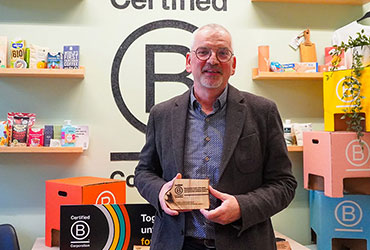
Précon achieves B Corp Certification!

Inspiring knowledge afternoon quality management software Quasydoc

NPN publishes Practical Guide to Dietary Supplement Safety

Need help with safe & fair products?
Our professionals will be happy to help you!